

Cocrystals in drug development: From theory to application
Gillian Gill - Solid State Manager 
Gillian Gill - Solid State Manager 
Word count: Approximately 2,200 words
Estimated reading time: 12 minutes
Building on our earlier blog, The rise and rise of cocrystals, this piece explores the topic in greater depth, examining the scientific principles, development strategies and practical considerations that underpin successful cocrystal programmes.
Cocrystals have become an increasingly important tool in the modern drug development toolbox. They have been reported in the scientific literature for decades (an early example being Hoogsteen’s cocrystal of 1-methylthymine and 9-methyladenine in 1963) and have been a subject of vigorous research and debate, increasingly so over the past 20 years.
Now, as modern drug discovery provides structures of increasing complexity, lipophilicity and impractical solubility, the identification of an appropriate cocrystal can potentially turn a challenging drug substance into a viable drug candidate.
Cocrystals have emerged in the literature as a means to complement the “pharmasphere,” with an approach that can be tuned, like salt forms, to a specific problem. In fact, since 2015, following the launch of the first FDA-approved cocrystal, Entresto (Novartis, a drug-drug cocrystal of sacubitril and valsartan), more than 10 cocrystal drugs have been approved for use.
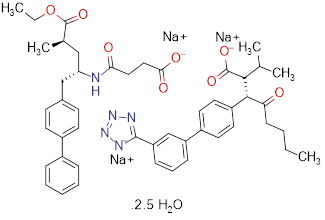
Figure 1 – Structural illustration of the sacubitril-valsartan sodium salt/hydrate cocrystal of Entresto
Onyx has been actively involved in the identification and development of novel cocrystals since 2008 and employs their selection to de-risk and facilitate the development of new drug substances.
This blog provides an introduction to and insight into how cocrystals can serve as an enabling development pathway for an active pharmaceutical ingredient (API).
What is a pharmaceutical cocrystal?
The United States Food and Drug Administration (FDA) defines pharmaceutical cocrystals as “crystalline materials composed of two or more different molecules, typically API and cocrystal formers (coformers), in the same crystal lattice in a defined stoichiometric ratio.” The API and coformer interact through noncovalent forces of varying strengths, such as hydrogen bonding and π-stacking/van der Waals forces, to form a single-phase crystalline material. Figure 2 illustrates simple graphic representations of the crystalline arrangements of various API: coformer or salt-former types.
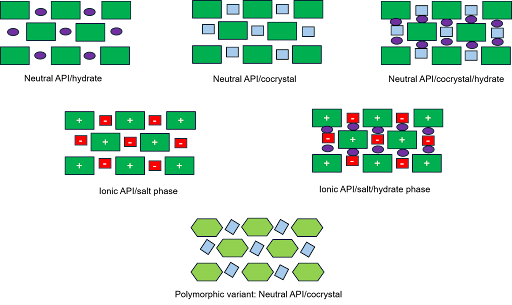
Figure 2 – Simple graphic representations of the crystalline arrangements of various API:coformer or salt-former types
Cocrystals represent an example of supramolecular chemistry, the formation of structure and order through the interaction of chemotypes capable of forming stabilising non-covalent interactions. Classic examples of molecules well cited for forming cocrystals are carbamazepine and nicotinamide (Figure 3). The concepts of heteronuclear and homonuclear synthons help explain how and why molecules such as these form stabilising interactions, and how to select cocrystal formers when screening for and identifying novel, enabling systems. Classic examples of such synthons are carboxylic acids, amides, phenols and heteroaryl nitrogen-containing molecules. In each case, these can interact to form either a donor or an acceptor motif, thereby enabling strong hydrogen-bonding interactions.
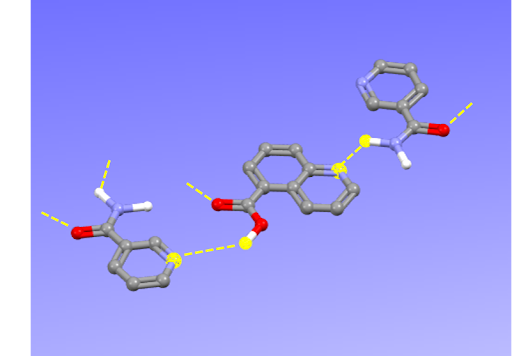
Figure 3 – Examples of supramolecular synthons and cocystal formers often found in screening libraries/example of a molecular network of hydrogen bonds within a fictional cocrystal
But the story is yet more complex when ionic cocrystals are considered (see Entresto). These comprise ionic multicomponent systems of a salt and an ionic or molecular complex in a stable organisation. Well-cited examples of this sort are those formed from carboxylic acids and amine hydrochloride salts (e.g., Fluoxetine, HCl (Prozac) and benzoic or succinic acid), as well as Lithium salicylate and L-proline (LISPRO). Many other examples exist, including mixed salt/cocrystal continuums. The works of Nair Rodriguez-Hornedo, Scott L. Childs and Mike J. Zaworotko will provide extremely useful insights.
Benefits of cocrystals
According to the Biopharmaceutics Classification System (BCS), Class II and IV drugs exhibit poor aqueous solubility and, hence, low bioavailability. Many modern drugs exhibit hydrophobic behaviour or poor wettability, limiting formulation options. Like salts, cocrystals can be exploited to afford improved drug substances and drug products, enhancing the performance of an API in a variety of ways. By selecting the properties of the coformer, one can attempt to tune the properties of the drug substance towards many differing attributes such as:
- Improved and sustained solubility (achieving the Spring-parachute effect)
- Improved dissolution
- Retarded dissolution/controlled release
- Improved stability/photostability
- Improving mechanical properties, such as poor flow and material handling
- Reduced hygroscopicity
- Improved compactability
- Elevated or depressed melting point
Of course, all of these attributes could be achieved through the art of salt formation, but then not all molecules can form a salt, or at least not a thermodynamically stable salt fit for manufacture, where a delta pKa of at least three units exists.
There are, of course, other key critical quality attributes of a drug substance and product that can be positively impacted through astute cocrystal design
- Purity considerations/purge of impurity
- Taste
- Morphological attenuation
- Deriving a solid form from an oily substance with commensurate improvement in bench stability
- Chiral resolution through diastereoisomeric cocrystal formation
- Intellectual property and product lifecycle management
Screening and selection
Design and in silico
As with any solid-form screening initiative, solubility is a critical factor to consider. But prior to that, how do you select the coformers? With a knowledge of the properties one is trying to optimise, selection can be made from a wide range of GRAS molecules acknowledged as safe by the FDA, MHRA and EMA. Structural considerations are a key component of screen design.
Increasing solubility is not the only point of leverage cocrystal selection provides. More complex attributes can be tuned, such as delayed release,
That said, simply matching heteronuclear synthons and homonuclear synthons on paper is not so straightforward. Predicting what will pack into a stable crystalline lattice is an undertaking well-suited to machine learning and in silico screening. In practice, a combined approach is often taken and has been utilised in-house to rationalise more complex systems that do not readily produce hits from screening. This supportive screening methodology has been implemented in conjunction with in silico tools available through the CCDC’s solid-form informatics suite. This robust tool statistically analyses the structural preferences of functional groups for cocrystal formation. The tool specifically uses the hydrogen-bond propensity (HBP) method and physicochemical data such as pKa to determine whether predicted structural motifs will form stable hydrogen bonds, in combination with other critical interactions, and predicts the likelihood of cocrystal formation.
Solid form and solubility – a foundation
The methodology that can be applied is well-documented. As stated, a sound understanding of the solubility properties of the API and its coformers is encouraged to enable screening modifications that perturb the dissolved fractions of both the API and its coformers.
A robust understanding of the polymorphic landscape is required to distinguish hits and mixed phases, including cocrystals, from simple mixtures of the input components. The inclusion of solvates and hydrates in this reference landscape is also important. These are, in effect, cocrystals in their nature and can perturb the ability to form a stable cocrystal by occupying and satisfying a molecule’s need to balance hydrogen bonding interactions between donors and acceptors within a stable solid form. In practice, understanding the conditions under which these may form enables their exclusion from a screen using a “better by design” approach to experimental workflows. In practice, the application of mixed solvent systems can be the bench chemist’s ally when considering how to avoid these unwanted solid states.
Cocrystal screening – empirical methodology and characterisation
A wide range of methods is well documented within the literature, including:
- Solvent crystallisation
- Slurry maturation
- Grinding – solid state
- Grinding – wet-assisted
- Heat-assisted grinding and mixing
- Melt crystallisation and quench techniques
- Sublimation
- Sonication/resonance mixing
A multi-component screen is typical, operating via small-scale and medium- to high-throughput techniques. The favoured in-house approach involves material observation and medium throughput rather than a less “reactive” high-throughput approach.
Testing is best suited to a cascade approach, in which hits are first assessed via high-throughput XRPD against reference data. Subsequent testing is then performed to deconvolute the contributions of the mixed or pure crystalline phases (Figure 4).
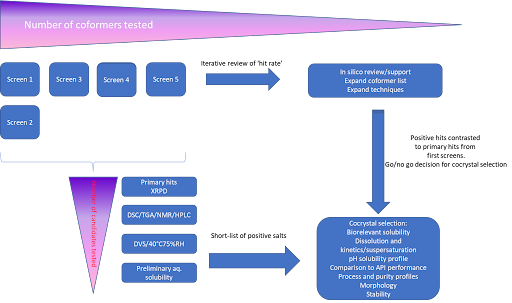
Figure 4 – Testing and selection cascade approach to cocrystal screening
Selection
It is well reported that, in some instances, mixed API:cocrystal phases are obtained. These are essentially hits that require further evaluation to determine the stoichiometry of the stable cocrystal phase to be ultimately selected for development. In some instances, particularly with more complex molecules, such as those that can form zwitterions, a mixed solid phase may exist in which the API is present in more than one state and with fewer or more than one molecule of coformer. Mixed salt/cocrystal states are also reported.
To determine the nature of a complex new solid phase, orthogonal testing is required. XRPD and DSC are the go-to screening benchmarks. For a deeper understanding of “where the proton sits,” techniques that can spectroscopically differentiate the interactions that stabilise a cocrystal should be used, such as infrared spectroscopy.
As an example, a neutral carboxylate (-CO2H) typically displays a strong C=O stretching band around 1700 cm−1 and a weaker C−O stretch around 1200 cm−1, while a carboxylate anion (-CO2−), due to resonance, displays a single C−O stretch in the fingerprint region of 1000−1400 cm−1. Such data may be used to confirm the presence of salt or a cocrystal. Solid-state NMR using 15N can also be used to determine shift differences between protonated and non-protonated nitrogen centres.
If a single crystal is eventually produced, robust data can be obtained on bonding in the solid state, with measurements of bond angles, lengths and hydrogen-bonding interactions to rationalise the stabilising features and the nature of the identified solid form.
Once a series of hits is identified and fully characterised, the cocrystals need to be scaled up. This is not always straightforward, depends on the method of formation from methodology applied during the screen and is beyond the scope of this blog. Selection is the point at which all critical quality attributes required of the drug substance are challenged through a series of indicative tests (Figure 2). The list of tests provided is not exhaustive; it aims to illustrate the performance indicators that are typically more challenging than with other development options during early preformulation risk assessment studies. Of course, process efficiency and scalability are also critical factors to consider, especially as the molecule progresses from lab to production scale and from early- to late-phase evaluation.
Intellectual property and lifecycle management
In addition to the benefits cocrystals can provide in selecting a development candidate, intellectual property rights can hold significant value. These may either protect a new drug candidate or extend the life or revitalise the therapeutic impact of an existing drug. For patents to be upheld, they must typically meet 5 main criteria:
1 Patentable subject-specific matter, e.g., a pharmaceutical agent
2 Novelty
3 Inventiveness (non-obviousness)
4 Utility (process or industrial applicability)
5 Sufficiently disclosed (clear to those skilled in the art – not vague)
For cocrystals that are novel, often difficult or not readily predicted in terms of their formation and more challenging, their physicochemical characteristics, meeting these criteria should not be seen as a significant hurdle. That said, one should always make a thorough review of prior art, as this may provide a significant pitfall to the novelty claim.
Final comments
When considering development options for a new chemical entity, it is recommended to perform a risk-benefit assessment of all viable development and preformulation approaches. This should be iterative and based on the growing body of data that articulates material characteristics and behaviour, grounded in a sound understanding of solid-state chemistry and materials science. Of these options, cocrystal development should not be overlooked and should be considered as a viable and accepted development pathway to optimise the performance of a drug substance.
To learn more about how Onyx has leveraged cocrystals in development over the past decade, contact us.
Supporting the statements made within this article, find below some common “Pitfalls and Challenges” highlighted from the general cocrystal literature
- In Vivo Instability (The “Parachute” Problem): A major risk is the cocrystal reverting to the less-soluble API in the gastrointestinal tract, thereby losing its solubility benefits.
- Hygroscopicity: While many cocrystals improve stability, some combinations can be more hygroscopic than the parent drug, leading to moisture-induced degradation or dissociation, particularly at high relative humidity.
- Inefficient Screening Techniques: Relying only on traditional screening can miss potential cocrystals. Conversely, relying solely on computational prediction can be unreliable for large, flexible molecules.
- Higher Dosage Hurdles: For high-dose drugs, the amount of coformer required may exceed IID limits, creating regulatory challenges.
- Scale-Up Difficulties: Transitioning from lab-scale grinding to industrial-scale manufacturing often encounters hurdles in controlling stoichiometry and polymorphic purity.
- Failed Predictions: In practice, predictive algorithms based on hydrogen-bond energy or molecular complementarity often overpredict success, resulting in few hits when experimentally validated.
- Polymorphism: Cocrystals can exist in multiple polymorphic forms, each with distinct stability and solubility profiles, complicating regulatory approval.
Strategy for Success
An integrated, systematic approach should be employed:
- Prioritise Coformer Safety: Start with IID-listed compounds.
- Use Mixed Screening Methods: Combine in silico screening (HBP, HBE) with medium- to high-throughput experimental screening (e.g., LAG).
- Be thorough and do not discard apparent mixed phases or amorphous phases with sharp, single melt endotherms, especially where hit rates for crystalline novel solids are low – be data-driven and interrogate the “why.”
- Evaluate Stability: Early testing of hygroscopicity and conversion potential in aqueous and biorelevant media is critical.
- Optimise the “Spring-Parachute”: Design for solubility, but ensure the coformer’s properties allow the drug to stay in solution longer, often supported by an excipient compatibility review with this specific aim in mind.