

Managing impurity and analytical strategy in early-phase process development
Dr Rebecca Matters - Process Development Team Leader  , Curtis Swift - Analytical Team Leader
Dr Rebecca Matters - Process Development Team Leader  , Curtis Swift - Analytical Team Leader
Word count: 1,654 words
Estimated reading time: 8 minutes
Impurities introduced during pharmaceutical manufacture are a serious issue, and compliance with permissible contamination levels is non-negotiable.
In this blog, Dr Rebecca Matters and Curtis Swift explain why a robust strategy to monitor and manage impurity formation, paired with a pragmatic, phase-specific approach, can be a powerful tool in process development.
The manufacture of pharmaceutical materials is very tightly controlled, with strict regulations around procedures and processes. Non-adherence can have severe consequences, ranging from reduced efficacy and reduced shelf-life of the drug substance to legal, financial and operational penalties for the manufacturer, not to mention the reputational damage and loss of trust. While standard operating procedures (SOPs) and a robust quality management system can ensure compliance, operations must also consider the chemical outputs of these manufacturing procedures. Implementing a robust strategy to monitor and manage impurity formation is crucial to avoid nasty surprises and costly rework.
This blog post outlines the benefits of a pragmatic, well-considered approach to impurity control, including the importance of a fit-for-purpose, phase-appropriate analytical strategy.
Impurities in drug substance manufacture: Knowing what to look for
In its simplest form, anything in a reaction mixture that is not the desired product can be considered an impurity, with unreacted starting materials, catalyst residues and traces of solvent as common contaminants. However, these are not the only sources; as any chemist knows, reactions rarely behave as they’re drawn in textbooks. A well-defined strategy for monitoring impurity formation, alongside an open mind regarding their identity and a well-formulated plan for their removal, is vital for a project’s success.
However, while it’s tempting to ensure that all material has 99%+ purity after every step, a pragmatic, phase-appropriate approach is essential. Commonly, liquid chromatography-mass spectrometry (LCMS) and high-performance liquid chromatography (HPLC) are used for in-process check (IPC) or intermediate (INT) analysis to track reaction progress. If the reaction product, final active pharmaceutical ingredient (API) and impurities are easily identifiable and traceable through the synthesis, early-stage programs can tolerate a lack of baseline resolution with generic methods applied to most in-process tests, except the final API purity test where robust chromatography is expected. It’s also important to keep in mind that during early-phase manufacture only those analytical methods used to test the final API need validation, which can help expedite process development.
Access to material during early development is critical and, as noted, a consistent impurity profile is arguably more important than unrealistically high total purity goals. If intervention is needed, addressing an optimised work-up and purification procedure can be a reliable approach. However, while this may suit early stages, as an asset moves through later development stages, emphasis will likely shift to establishing critical process parameters (CPPs) and understanding how or why an impurity forms through a one-factor-at-a-time (OFAT) or Design of Experiments (DoE) approach. This, in turn, will establish meaningful specifications that meet critical quality attributes (CQAs).
Known unknowns and unknown unknowns: Better the devil you know
There are three broad classes of impurities encountered during synthesis of pharmaceutical products:
- Organic (from side-products, racemisation, polymorphism or residual reagents)
- Inorganic (commonly metals or bases)
- Solvents.
While the presence of solvents and starting-material impurities, in this case, “known unknowns”, can be anticipated and analytical techniques devised to detect them, “unknown unknowns” are much more troublesome. Good chemical knowledge can help predict “unknown unknowns” by knowing what to look for. For example, when working with amides, common contaminants can include di-acylated species (imides), N-acyl ureas, or racemised materials. A working knowledge of the processes that tend to generate “hard to detect” oligomers is also very useful. Scale-up programs are rarely linear; impurities seen during Phase 1 scale-up are not necessarily seen during Phase 2 scale-up, and both the identity and quantity of impurities can change.
In short, reaction profiles change, and impurity profiles are dynamic. A robust strategy for identifying and removing impurities, along with strong collaboration between analytical and process teams, is essential. This process is iterative: both teams respond to each other’s needs, with the chemistry team providing the analytical team with authentic samples of relevant impurities to support method development, and the analytical team adapting methods as the chemical process evolves. Techniques such as LCMS and nuclear magnetic resonance (NMR) enable rapid impurity identification and inform the development team of a pragmatic, appropriate removal strategy.
Engaging an experienced contract development and manufacturing organisation (CDMO) can be a real advantage, and a CDMO that encourages close integration and collaboration between process chemistry and analytical chemistry is a vital asset, enabling faster decisions that directly benefit the project and the client.
Impurity strategy: A case study with palladium
All reactions contain materials not present in the final API or key intermediate, including solvents and their degradation products. However, the origin of these impurities can vary, so having a strategy to detect and remove them is good practice.
A good example is the Suzuki–Miyaura coupling (Figure 1). While this versatile coupling reaction offers many advantages, developing a robust strategy for the control of impurities is vital, especially since some impurities may be classified as mutagenic. An appropriate strategy for this reaction will likely comprise three aspects: identifying any contaminants present, implementing methods to control their formation and/or removal of impurities and development a regulatory specification.
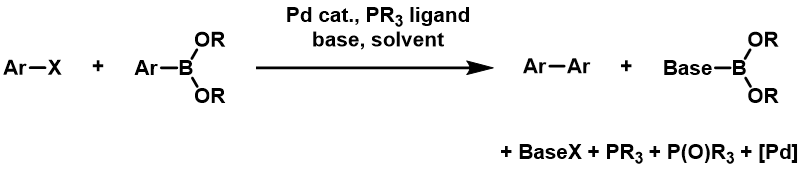
Figure 1: Large-scale Suzuki–Miyaura couplings are regularly used to install functionality into APIs at a late stage of synthesis.
Strategy stage 1: Impurity identification
Identifying and quantifying impurities formed during a synthetic procedure is critical and is directly governed by the International Council for Harmonisation of Technical Requirements for Pharmaceuticals for Human Use (ICH), specifically the ICH Q3A (impurities), Q3C (solvents) and Q3D (elemental) guidelines. For the Suzuki reaction shown, the boronic acid/ester means the ICH M7 guidelines (mutagenicity) may also apply.
Many contaminants in the reaction shown can be anticipated, including residual starting materials, catalyst, ligands or solvent. However, common side products also include dehalogenated and protodeboronated species and homocoupled dimers. Because both organic and inorganic contaminants are likely present, the analytical technique(s) required for detection and quantification will vary: one size will not fit all. Furthermore, requirements change depending on the project phase. Pragmatism during analysis is crucial, and speed and purity should always be balanced.
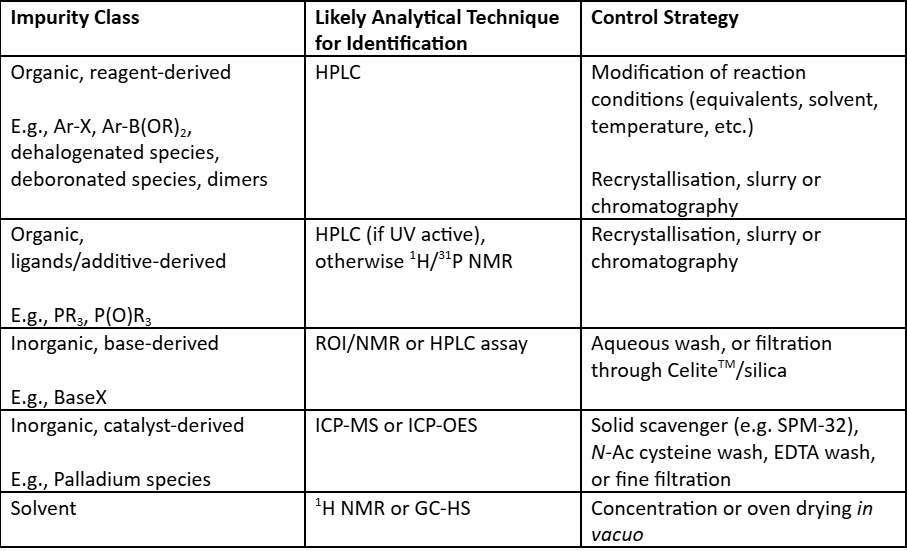
HPLC or NMR can identify most organic contaminants. Bespoke HPLC assays or residue on ignition (ROI) are relatively common, as are inductively coupled plasma mass spectrometry (ICP-MS) and optical emission spectrometry (ICP-OES). For best results, close collaboration between process and analytical teams ensures comprehensive impurity detection and quantification. Table 1 shows the analytical techniques that may be used to identify contaminants in the Suzuki–Miyaura coupling shown.
Strategy stage 2: Impurity removal
Once impurities are identified, strategies can be devised to control or remove them, with the mantra “simpler is better” often true. A phase-appropriate, pragmatic approach should always be followed. Higher levels of organic impurities can be tolerated or justified during early-phase development, but later phases may require toxicology data. With the Suzuki–Miyaura reaction shown, there are also additional considerations:
- Boronic acids or boronic esters may be mutagenic; therefore, ICH M7 guidelines should be followed. Depending on the required sensitivity, a specific HPLC or LC-MS method may be required.
- Palladium removal can be less effective upon scale-up; small-scale batches should comfortably meet the ICH Q3D limit to mitigate against this. Orthogonal purification techniques, such as scavenger treatment, an EDTA wash, or fine filtration, may be necessary to remove all palladium species formed.
Table 1: How a strategy for control of impurities may look for a general Suzuki–Miyaura coupling.
Strategy stage 3: Setting the specification
With all impurities identified and control measures established, the final stage is translating these data into a meaningful regulatory specification. In accordance with ICH Q3A, Q3C, Q3D and M7 guidelines, specifications must ensure patient safety while also reflecting the asset’s clinical phase. Setting specifications is where a phase-appropriate approach matters most: forcing tight, later-phase limits into a Phase 1 process can stall a program. Instead, early-stage specifications should be based on safety data and the process’s actual capability, informed by information gathered during the identification and removal stages of the development strategy. Specifications can, and will, tighten naturally as manufacturing history and process familiarity grow. This data-driven balance relies on close integration between the process and analytical teams.
By combining the chemist’s understanding of reaction limitations with the analyst’s tracking of impurity trends across scale-up batches, teams can establish specifications that are scientifically justified, regulatory compliant and optimised for clinical speed.
Keep your compounds close, and your impurities closer
By adopting a phase-specific, evidence-based approach, identifying and implementing impurity mitigation strategies can be invaluable during development of a route to a drug substance.
At Onyx, we work with our customers to embed control strategies in manufacturing processes from the start and future-proof approaches, thanks to our extensive knowledge of later-stage and commercial manufacture. We work closely with our customers to produce drug substance specifications that comply with ICH guidelines and are achievable and reproducible across multiple batches. This supports our and our clients’ ultimate goal of providing safe and effective treatments for patients.